Elevating Digital Communication with the Remote Work 3D Icon Pack
In the evolving landscape of digital design, visual assets play a pivotal role in how users perceive and interact with online platforms. As remote work transitions from a temporary necessity to a permanent fixture in global business operations, the demand for high-quality, relatable imagery has surged. The Remote Work 3D Icon pack emerges as a specialized resource designed to meet this need, offering a distinct aesthetic that balances professionalism with approachability. For designers, HR professionals, and content creators, understanding the nuances of this asset pack is essential for making informed decisions about their visual strategy.
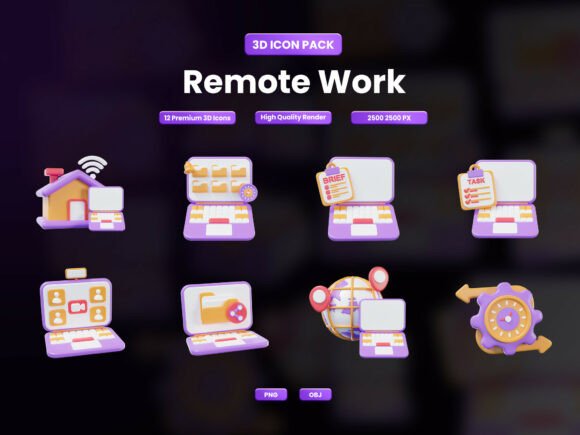
This collection is not merely a set of generic symbols; it is a curated suite of twelve high-resolution PNG files, each rendered at 2500x2500 pixels with transparent backgrounds. The defining characteristic of this pack is its "chubby" 3D style—a design trend that utilizes soft edges, rounded forms, and vibrant colors to create a friendly and non-intimidating user experience. This stylistic choice is particularly effective in modern workplace environments where reducing digital fatigue and fostering a sense of community are primary goals.
Understanding the Chubby 3D Aesthetic in Professional Contexts
The term "chubby style" in 3D design refers to objects that are slightly inflated, with smooth surfaces and generous curvature. Unlike sharp, angular, or hyper-realistic 3D models, these icons feel tactile and inviting. When applied to the concept of remote work, this aesthetic serves a specific psychological function. It softens the often sterile nature of corporate communication tools, making dashboards, onboarding materials, and internal newsletters feel more human-centric.
The Remote Work 3D Icon pack includes essential elements such as laptops, WiFi signals, cloud storage units, home office setups, and task boards. These are not abstract representations but recognizable tools that remote workers engage with daily. By rendering them in a smooth, colorful format, the icons bridge the gap between functional utility and visual appeal. This is crucial for productivity platforms and task management apps where user engagement can drop if the interface feels too rigid or bureaucratic.
Furthermore, the inclusion of futuristic elements like VR headsets, avatars, crypto coins, holograms, and portals indicates a forward-thinking approach. While the core focus is on current remote work practices, these additional assets allow designers to hint at the emerging metaverse and Web3 integrations that may shape the future of digital collaboration. This versatility makes the pack suitable for both present-day applications and speculative design projects focused on next-generation workspaces.
Comparative Analysis: 3D Icons Versus Flat Design and Illustrations
When evaluating visual resources, designers often weigh 3D icons against flat design vectors and custom illustrations. Each format has distinct strengths and tradeoffs, and the right choice depends largely on the project’s specific requirements.
Flat design has long been the standard for web interfaces due to its simplicity and fast load times. However, as the digital space becomes increasingly saturated, flat icons can sometimes appear generic or lack depth. The Remote Work 3D Icon pack offers a middle ground. It provides the clarity and recognizability of flat design but adds dimensionality and texture that capture attention more effectively. The high-resolution renders ensure that these icons remain crisp on retina displays and large monitors, a common setup in home offices.
Compared to custom illustrations, pre-made 3D icon packs offer significant efficiency benefits. Commissioning bespoke 3D art is time-consuming and expensive. For startups, HR departments creating onboarding materials, or social media managers needing consistent visuals, a ready-made pack ensures brand consistency without the overhead of a full design cycle. The tradeoff is less customization; however, the neutral yet polished style of this pack allows it to adapt to various brand color palettes with minimal adjustment.
Another alternative is stock photography. While photos provide realism, they often suffer from authenticity issues. Staged photos of people working from home can feel forced or outdated. 3D icons, by contrast, are timeless and universally relatable. They avoid the cultural or demographic specificities that might alienate certain segments of a global remote workforce. This makes the Remote Work 3D Icon pack a safer and more inclusive choice for international companies.
Practical Applications and Best-Fit Scenarios
Identifying where this asset pack delivers the most value requires looking at specific use cases. The versatility of the included files means they can be deployed across multiple touchpoints in the employee and customer journey.
- HR Onboarding and Internal Communications: New remote employees often feel disconnected. Using friendly, high-quality visuals in welcome decks, policy documents, and training modules can make the information feel more accessible. Icons representing cloud storage or task boards help visualize complex workflows, reducing cognitive load for new hires.
- Productivity Dashboards and UI Design: For SaaS platforms focused on project management or team collaboration, these icons can serve as navigation elements or status indicators. The clear, chubby style ensures they are easily distinguishable even at smaller sizes, enhancing usability without sacrificing aesthetic appeal.
- Social Media and Content Marketing: Brands discussing remote work trends, work-life balance, or digital nomad lifestyles need engaging visuals for LinkedIn, Instagram, and Twitter. The vibrant nature of these 3D icons stands out in crowded feeds, increasing click-through rates and engagement compared to text-only posts or generic stock images.
- Presentation Decks and Infographics: Consultants and team leaders frequently present data on remote productivity. Integrating these icons into slides breaks up text-heavy content and provides visual anchors for key concepts like connectivity, security, and collaboration.
It is important to note that while the pack includes futuristic elements like crypto coins and VR headsets, its primary strength lies in everyday remote work scenarios. If a project is strictly focused on traditional corporate office settings, the home-office-specific icons might be less relevant. However, for any organization embracing flexibility, these visuals align perfectly with the modern narrative of work.
Evaluating Technical Specifications and Limitations
From a technical standpoint, the Remote Work 3D Icon pack is delivered as PNG files with transparent backgrounds. This format is widely supported and easy to integrate into most design software, including Figma, Adobe Creative Cloud, and Canva. The resolution of 2500x2500 pixels is ample for high-density screens and print materials, ensuring that the icons do not pixelate when scaled.
However, there are limitations to consider. PNGs are raster images, meaning they are not infinitely scalable like SVG vectors. While the high resolution mitigates this for most digital uses, designers who need to scale icons to massive billboard sizes or require extensive color manipulation via code might prefer vector-based alternatives. Additionally, because these are pre-rendered 3D models, the lighting and angle are fixed. Users cannot rotate the objects or change the light source dynamically without returning to 3D modeling software, which requires specialized skills.
For most digital projects—websites, apps, social media, and presentations—these limitations are negligible. The convenience of ready-to-use, high-quality renders outweighs the flexibility of raw 3D files for the majority of users. The key is to assess whether the fixed perspective aligns with the design layout. In most grid-based or card-based UI designs, the frontal or isometric views typical of such packs integrate seamlessly.
Making the Right Choice for Your Digital Projects
Deciding whether to invest in the Remote Work 3D Icon pack depends on your project’s tone, timeline, and audience. If you are aiming for a sleek, minimalist, or ultra-corporate look, flat monochrome icons might be more appropriate. However, if your goal is to create a warm, engaging, and modern digital environment, this pack offers a compelling solution.
The inclusion of both practical tools (laptops, WiFi) and futuristic elements (VR, holograms) provides a breadth of coverage that few other packs offer. This duality allows brands to position themselves as both grounded in current best practices and open to future innovations. For HR teams, this can signal a progressive company culture. For tech products, it suggests a user-friendly interface that doesn’t sacrifice sophistication.
Ultimately, the value of this asset pack lies in its ability to humanize the digital workspace. In an era where remote work can feel isolating, visuals that are soft, colorful, and relatable help build a sense of connection. By choosing resources that prioritize user experience and emotional resonance, designers and decision-makers can create more effective and enjoyable digital interactions. Whether for a startup launching its first productivity app or an established enterprise revamping its internal communications, the Remote Work 3D Icon pack represents a strategic investment in visual clarity and brand personality.
If you have specific questions regarding licensing, usage rights, or compatibility with your existing design stack, it is advisable to contact the provider directly. Ensuring that the assets align with your technical and legal requirements is a critical final step before integration.